Exploring Emotional release within Music.
I’ve always been interested with the idea of how music can have a powerful effect over people. Music is varied and endless! And so are people’s reactions towards it. Essentially music has become a tool for musicians to express their pain and vulnerability, this idea of an “emotional release” can be expressed with their lyrics and performance.
The idea surrounding my project is to explore the ways in which an emotional release can be portrayed within music and most importantly my own. To explore this idea thoroughly I’m going to be looking into the ways in which I believe an emotional release can clearly be displayed. I’m going to be focusing on song writing, performance, videography, stage presence, the exploration of space and the influences that informed my practice. Through this exploration I’m going to produce a body of work by creating an EP, and a music video, to clearly demonstrate how emotional release has affected my own creative practise. Before starting my research, I asked myself this question: When Musicians explore emotional release within their music, how does it affect the audience? Anjali Bhatara writes that “Music is also a complex auditory signal with the capacity to communicate emotion rapidly and effectively and often occurs in social situations or ceremonies as an emotional unifier” (Bhatara, 2014)
From this we can see that the effect of music can be meaningfully present in various different contexts. However, the goals and responses to the music itself is related to the intention of the musician and what they’re trying to get the listener to feel. When talking about intentions of the musician, they can use an abundance of musical cues to communicate certain emotions to the listener. For example, the comparison of major and minor chords is a musical cue to communicate the feeling of happiness and sadness. Thomas Eerola explains this concept further by saying:
“the distinction between happiness and sadness has received considerable attention—these emotions are known to be quite clearly distinguished through cues of tempo, pitch height, and mode: the expression of happiness is associated with faster tempo, a high- pitch range, and a major rather than minor mode, and these cues are reversed in musical expressions of sadness.” (Eerola, 2014 ) Linking Eerola’s concept with my own practice, I’ve begun to realize how a musical cue can add another level of depth and meaning to my songwriting. Along with my lyrics, my musical choices can set the tone of my song and how it’s going to be perceived by my audience.
Below I’ve added a lyric extract from one of my songs that I intend to add into my body of work. I’ve also added the chord progression, to show how the chordal movement adds another layer of depth and meaning to the lyrics.https://soundcloud.com/yasmine-st-croix/last-friend-section/s-lQgLl
“Could this last bottle of gin be my last ever friend? Baby you need to know, I need to feel warm again”
Bb D7 Gm Bb Bbsus4 (St.Croix, 2017)
From analysing my lyrics, you can see that I’ve referenced that the character in the song has a dependency to alcohol. To a listener you would immediately assume that the song is about a negative experience, which would resonate with them in a particular way. Our dependence on cultural codes regarding harmony would assume a minor chord progression to match “sad” lyrics, which is why I feel that it is structurally appropriate to say that I’ve used a minor chord progression to suit the tone of my lyrics.
Growing up, I was always listening to genres like Blues and Soul. I believe that my song writing has been heavily influenced by the Blues, and would be the best musical fit to demonstrate emotional release within my music. Jesse Stein berg describes a Blues song as being “the fact that, when one sings one, [it] is literally expressing that one has the blues. Blues songs are melancholy or mournful. They are about pain, strife suffering, difficulty, being generally doomed and so forth.” (Steinberg, 2012)
In a lot of my song writing, I like to explore writing about everyday life. Themes such as pain, heartbreak, and loss. These themes are quite reflective for me as they allow me to explore my personal pain, by turning it into a song.The same can be said for the Blues. From listening to artists such as Willie Dixon to Etta James, you can really hear the vulnerability and pain that they portray with in their lyrics. Ralph Ellison writes that:
“The blues is an impulse to keep the painful details and episodes of a brutal experience alive in one’s aching consciousness, to finger its jagged grain, and to transcend it, not by the consonants of philosophy but by squeezing from it a near-tragic, near-comic lyricism.” (Ellison, 2002) I agree with Ellison here as he suggests that Blues songwriters create this sense of honesty, and tend to not hide behind the truth, as that de-values their own personal pain. Below I’ve added a lyric extract from one of my songs, along with Etta James’s “I’d rather go Blind”
“Could it be human nature to love a man or two
Baby the last ten years was so hard for me to do.”
(St.Croix, 2017)
Something deep down in my soul said, “Cry Girl”
When I saw you and that girl, walking out
I would rather, I would rather go blind boy
Than to see you, walk away from me child, and all. (James, 1968)
A lyrical comparison…
My song explores a lot of lyrical themes that Steinberg mentions. The lyric cited from my song suggests that the character has suffered a lot from the relationship that they’ve been in. Etta James also explores this idea of heartbreak in the Lyric “I would rather, I would rather go Blind boy. Than to see you walk away from me child and all.”From this lyric extract, you can clearly see the desperation and pain from feeling the Blues. Musicians can also demonstrate an emotional release through performing. Stage presence is one of the main visual elements of a performance. Karen Hagberg defines the topic in a broader sense in saying that its
“everything from a performer’s walk, bow, facial expression and dress, to an ensembles portrayal of a single, unified entity; from the condition of the chair, music stands, and piano to the mechanics of smooth stage management” (Hagberg, 1943) I agree with Hagbergs definition of what stage presence is, I think she’s also suggesting that stage presence adds to the experience of the audience. It creates this idea of belonging and it also invites the audience to be a part of the performance.
I’ve been heavily influenced by Blues and Soul singers such as Etta James and Janis Joplin. They both have an ability to fully immerse themselves in the performance of their songs. Paul Bond writes that “Etta James’s singing was truthful. With every song, she performed she delivered its powerful emotional content. That feeling was instilled early in her life, and led her to become one of the most expressive vocals in the music of the 20thcentury” (Bond, 2012)Out of the many performances Etta James has done, her performance of “I’d rather go Blind” live in Montreux “1975 Montreux”(James, 1975)clearly shows her theatricality and expressiveness in her performance. At 7:33 after she finishes the song she covers her face. I believe that this is a form of symbolism to suggest that she has finally become blind. She really expresses her vulnerability as a performer, because she sings about her own heartbreak. Everyone has experienced heartbreak to some capacity, which is why this song would have an emotional impact to listeners.
Within my own practice I do believe that I need to work on my own performance delivery. I want to encapsulate this idea of becoming a shamanistic performer. Jacques Mushaandja describes the idea of a shamanistic performer being “At the core of it all is the idea that the performance generally carries healing qualities. A performer takes on some kind of shamanic role in which they trance and transport their audiences through their narratives. Every performers intention may not be centered on healing, even though they possess the unique ability to make the audience reflect and deal with their scars.” (Mushaandja, 2016)
From past gigging experience, I believe that I haven’t paid enough attention to creating an experience for my audience. This is something I’m going to work on more within my own practice, and show in the body of work. One of the ways in which I’m going to develop this idea of becoming a shamanistic performer is through my music video.
I believe that the singer-songwriter inhabits the space in which their song is performed, this is why I felt it was very important to find a space which allowed me to create an experience, for my audience who intend to watch the video. I am going to film my music video at the Jazz Café, this is a venue which has had many musicians perform at such as D’Angelo and Amy Winehouse. This space, particularly this venue, is significant to the genre of music I am exploring so it adds weight to my performance because of its historical importance and all of the people who have performed on that stage before me. The intention of this video is “momentousness”, there’s a big stage, a big venue, a big band, a big song and a big venue name. As previously discussed Blues writers find expression of pain important, and mirror this in their performance and arrangement. Because of this I have chosen a full band arrangement, and the intention of “momentousness” to reflect how huge grief feels.
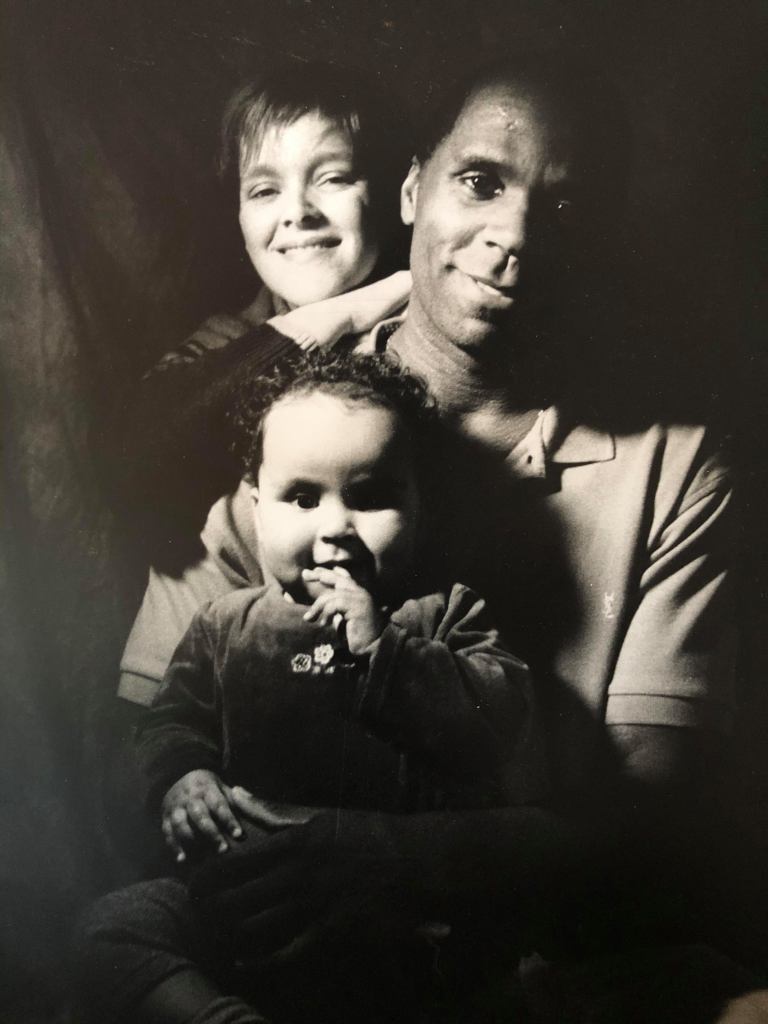
Family Photo
The Song I’m going to perform in this music video is one that is very personal to me, its allowed me to access my own pain from past experiences. Losing someone close to you is something that lots of people can relate to or are afraid of. For this reason, I want there to be distance between me and the song, so that the audience can see their personal experiences reflected rather than just mine. One of the ways that distance will naturally be created is the technological barrier, I won’t be in the room. In some ways, it’s easier for audiences to watch a video than be confronted with the actual pain and closeness of the experience. Another aspect of distance is the space between me and my usual practice, I’m going to be wearing more dramatic clothing, which is something I wouldn’t normally do, so that the audience can see that there is a visual distance from me as a musician and the character I’m representing in the song.
Works Cited
Bhatara, A., 2014. Expression of Emotion in Music and Vocal Communication. Frontiers Reasearch Topics, August .p. 6.
Bond, P., 2012. “Sing like your life depends on it”. january.
Eerola, T., 2014 . Emotional expression in music: Contribution,linearity, and additivity of primary muscial cues. Frontiers in Psychology , August .p. 7.
Ellison, R., 2002. Living with Music: Jazz Writings.
Hagberg, K., 1943. Stage Presence from head to Toe: A Manual for Musicians.
James, E., 1975. Id Rather go Blind ( Live at Montreux).
Mushaandja, J., 2016. Chanting Warrior.. Revisiting the Performer as Shaman. The Namibian , p. 16.
St.Croix, Y., 2017. Last Friend. [Sound Recording].
Steinberg, J. R., 2012. Blues- Philsophy for Everyone: Thinking Deep and Feeling Low.
 Yasmine's Creative Research Project